
Eric Miller, Toronto’s condo explosion is just getting started: A record 100 towers could go up every year — and these neighbourhoods will be most impacted, Toronto Star, March 11, 2023.
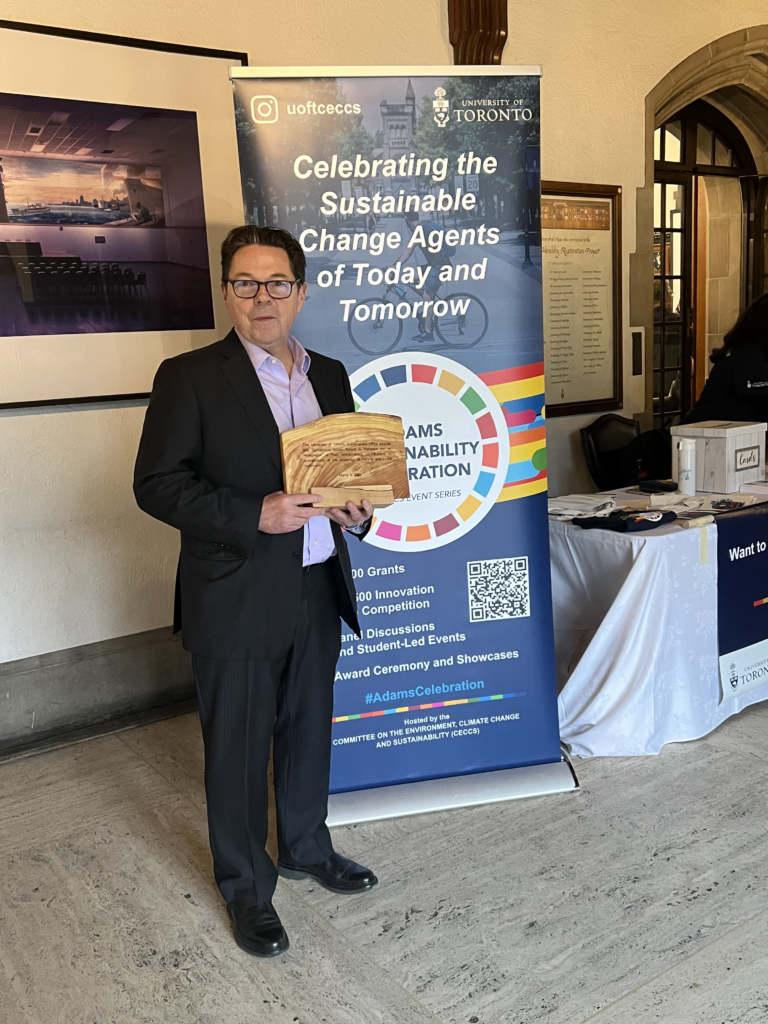
Above: Purolator's Dr. Daniel Baron (L) accepts U of T Sustainable Action Award from Scott Hendershot (R), Senior Manager, Sustainability Office, University of Toronto, at the Adams Sustainability Celebration Award Ceremony, March 3, 2023. (Photo: Tory Grewar)
Purolator Inc. was awarded the University of Toronto Sustainable Action Award, External Business or Partner category, on March 3, 2023, at the 2022-23 Adams Sustainability Celebration Award Ceremony and Innovation Pitch Prize Competition held at Hart House, University of Toronto.
The award recognizes individuals and teams who make tangible contributions to sustainability at U of T. Purolator received the award for the recent launch of their Urban Quick Stop mini hub pilot project on the U of T St. George campus.
The Urban Quick Stop serves as a mini hub for couriers on electric cargo bikes to retrieve and deliver packages to the surrounding areas, thus reducing the need for traditional courier delivery trucks. This results in a more sustainable approach to delivering and less traffic congestion.
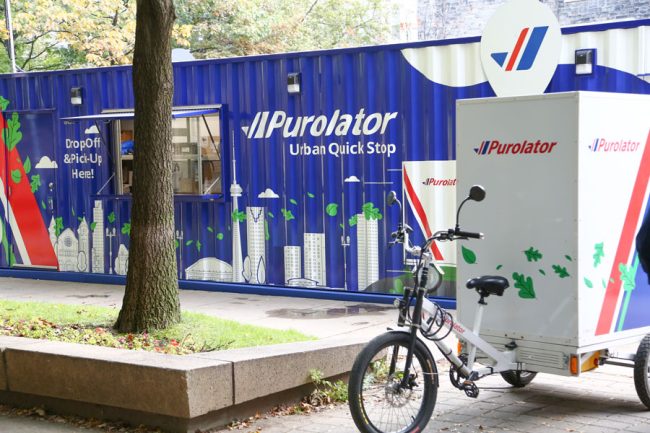
Our Urban Quick Stops and our partnership with the university is helping address challenges associated with last-mile delivery.
Additionally, the involvement of U of T graduate and undergraduate students in this project, and as part of Purolator Research Chair retained activities, has been invaluable. They have brought new ideas and perspectives, helping us continuously improve and innovate.
Khelil Khelil, Senior Manager of Applied Research and Innovation, Purolator
In partnership with the university, Purolator expects to achieve many sustainability benefits, including a reduction of approximately 5,800 km travelled per year on the U of T campus and neighbouring community roads. This translates into approximately 2.3 tonnes of CO2 emissions per year. The project also reduces the emission of nitrogen oxides (NOx), a pollutant that causes respiratory health problems, leading to measurable health impacts.
Purolator is most deserving to receive the Sustainable Action Award, as an outcome of their leadership toward making this project happen on the University of Toronto campus. It is a unique example of sustainability research ‘hitting the road’.
Matthew Roorda, U of T civil engineering professor and Canada Research Chair in Freight Transportation and Logistics
Purolator states that they are proud to partner with the University of Toronto and look forward to expanding their Urban Quick Stops across Canada in the future.
As their prize, Purolator received a plaque made out of honey locust wood reclaimed from the U of T Landmark Project. The inscription reads: "The University of Toronto Sustainability Office awards this Sustainable Action Award to Purolator Inc. in recognition of their extraordinary contributions to sustainability at the University of Toronto and in the community."
The 2023 Adams Sustainability Celebration Innovation Prize pitch competition and award ceremony is supported by the donation of Wendy Adams.
Adams Sustainability Celebration Award Citation
Purolator, in partnership with University of Toronto, has established a successful e-cargo tricycle demonstration project.
On August 22, 2022, Purolator replaced delivery trucks on the University of Toronto St. George campus, and in neighbouring communities, with e-cargo tricycles operating from a minihub located at 60 St. George Street.
This pilot is demonstrating the potential for e-cargo tricycle deliveries with potential expansion to other locations across Canada. Purolator is now delivering more sustainably on campus, with reduced emissions, fewer cyclist conflicts, and truck driver health improvement. Gasoline powered trucks have been replaced by electric cargo tricycles, leading to measurable health impacts.
Courier trucks emit about 1.4 g of nitrogen oxides (NOx) per km, a pollutant which causes respiratory health problems. The project results in an estimated reduction of 800 g of NOx annually from Purolator trucks.
A long list of graduate and undergraduate students have been involved in research associated with this project. These include women, Black and Muslim students, all under-represented groups in transportation and logistics.
U of T installed air quality sensors inside the cab and outside the cab of a Purolator truck. U of T found that drivers were exposed to a 25% higher rate of particulate matter (PM2.5) in the cabs of their trucks, which has been eliminated for e-cargo tricycle drivers.
In addition, truck traffic has been reduced by approximately 5800 km per year on campus and in the neighbouring communities. This translates into approximately 2.3 tonnes of CO2 emissions/year.
The project is also an economic benefit for Purolator, since the cost of operating and maintaining the electric cargo bikes is significantly lower.
Aside from obvious benefits from zero emissions vehicles, safety improvements exist for cyclists on campus. Trucks in traffic and parked on the roadside create safety conflicts with cyclists, which have been virtually eliminated with e-cargo tricycles.
They plan to expand the pilot to locations across Canada.
Purolator has worked for years in partnership with University of Toronto, the City of Toronto, Pembina Institute, and their research funding was matched by City of Toronto, Region of Peel, and NSERC. Two items required approval from Toronto City council (approval of electric cargo bikes over 120kg, and approval of a minihub on City of Toronto parking spots), which required a major advocacy effort.
Purolator is most deserving to receive the Sustainable Action Award, as an outcome of their leadership towards making this demonstration project happen on the University of Toronto campus. It is a unique example of sustainability research ‘hitting the road’.
With files from U of T Sustainability Office and Purolator Inc.
The University of Toronto Transportation Alumni Network (UTTAN) hosted a successful evening reception at U of T's elegant Massey College Common Room on February 9, 2023.
The event featured light refreshments and an opportunity to catch up with fellow alumni, faculty, friends and students who are all working in the transportation field.
Ann Marie Chung, UTTAN Executive Committee Chair, and Professor Eric Miller, Mobility Network Director, each addressed the crowd with a warm welcome to celebrate the in-person gathering and the waning of the COVID-19 pandemic. The support of sponsors was also acknowledged with gratitude.
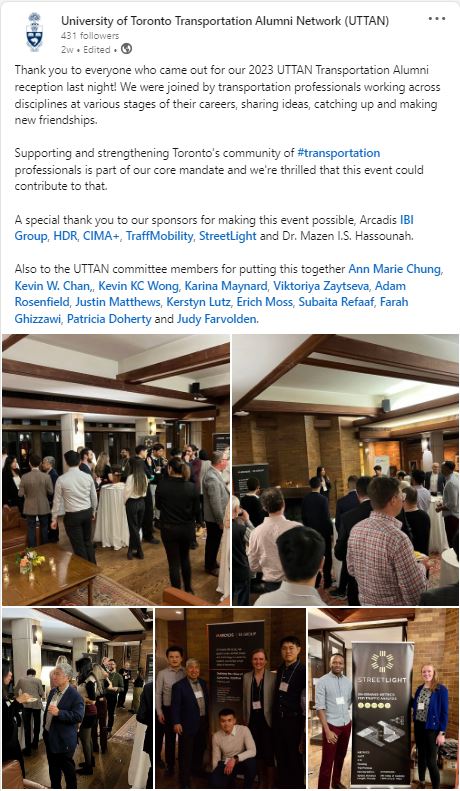
Thank you to everyone who came out for our 2023 UTTAN Transportation Alumni reception last night! We were joined by transportation professionals working across disciplines at various stages of their careers, sharing ideas, catching up and making new friendships.
Supporting and strengthening Toronto's community of transportation professionals is part of our core mandate and we're thrilled that this event could contribute to that.
University of Toronto Transportation Alumni Network (UTTAN) LinkedIn post, February 10, 2023.
Transportation types mixed and mingled
Among the 80 reception attendees, transportation researchers at University of Toronto were well represented, as were independent consultants and transportation professionals employed at a variety of organizations, including: Access Planning; Alta Planning + Design Canada, Inc.; Arcadis IBI Group; Arup; CIMA+; City of Hamilton; City of Toronto; HDR; Left Turn Right Turn; Metrolinx; Mott MacDonald; Ministry of Transportation of Ontario; Parsons Inc.; Ratio.City; Steer; StreetLight Data; The Atmospheric Fund; Waterfront BIA; and WSP.
Sponsors support UTTAN activities

UTTAN activities are generously supported by Tier 1 sponsors Dr. Mazen I.S. Hassounah, Arcadis IBI Group, CIMA+, and HDR, and Tier 3 sponsors TraffMobility Engineering Inc. and Streetlight Data.
Many sponsors further demonstrated their support of alumni activities by attending the reception.
UTTAN posts thank you on LinkedIn
About the University of Toronto Transportation Alumni Network (UTTAN)
Established in 2018 to bring together generations of U of T graduates who work in transportation, UTTAN is a volunteer-run alumni community that plans events and programs for alumni and current U of T students interested in the transportation field.
Connect with UTTAN on Facebook or LinkedIn and subscribe to email updates.
Professor Hugo Yoshizaki presented the webinar "The night deliveries pilot project in São Paulo: Lessons learned from a practitioner point of view" on Friday, March 3, 2023, from 11 AM to 12 PM.
The webinar was simultaneously screened to a live audience at the University of Toronto ITS Lab.
Abstract
This talk presents the main results of the successful off-hour delivery (OHD) pilot project in the city of São Paulo, Brazil, in 2015. The pilot engaged all major stakeholders in urban distribution, such as local authorities, shippers, carriers, and receivers, with the aim to determine the main requirements, constraints, opportunities, and threats for establishing a public policy related to shifting deliveries to late night to mitigate traffic congestion.
The primary focus was on safety and noise, besides productivity aspects of travel time, truck speed, and delivery time.
The pilot was very successful, with no registered complaints of noise or security incidents. Travel speeds were obtained from GPS tracking data. We compared daytime and night operations and productivity in some supply chains improved significantly, but noise and safety must be carefully controlled to guarantee the program's success.
About the speaker
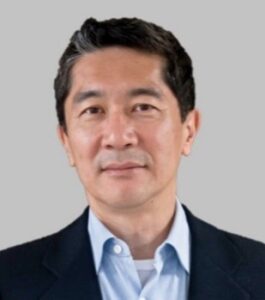
Hugo Yoshizaki is a senior professor of the Department of Production Engineering at Polytechnic School, University of São Paulo (USP), Brazil. He is co-director of the Center for Innovation in Logistic Systems at USP and has been the scientific director of the Centre for Disaster Research and Education (CEPED) at USP from 2013 to 2019. He was research affiliate at the Massachusetts Institute of Technology (M.I.T.) Center for Transportation and Logistics in 2019, and senior research fellow at the London School of Economics and Political Science in 2008. He is a member of the TRB Standing Committee on Urban Freight Transportation and former Vice-President, Americas, of the Production and Operations Management Society (POMS). He is also a member of the Board of the Brazilian Logistics Association — ABRALOG.
Professor Yoshizaki´s research interests are in sustainable logistics, logistic network design, megacity logistics, humanitarian operations management, and interactive visual analytics. He has published eight books and about 150 papers in journals and conference proceedings.
He coordinated the successful pilot project on Off Hour Deliveries in São Paulo in 2015.
Yoshizaki's presentation deck
Presented by the Smart Freight Centre and the University of Toronto ITE Student Chapter, UT-ITE.
The Transit Analytics Lab (TAL) at Mobility Network hosted the virtual seminar "Improving safety and security in transit systems" by Jacqueline Darwood, Program Director, Transit Expansion at City of Toronto, on February 28, 2023.
TAL Director, Professor Amer Shalaby, welcomed attendees to the seminar, and introduced guest speaker Jacqueline Darwood.
Darwood's talk touched on improvements in station planning/design and rail operation and simulation; physical and cyber threats; and much more.
Transit customers rely on transit operators to provide reliable and safe day-to-day public transit services.
You might wonder why I start off by saying this.
Because we all want transit to be reliable, but if it's not safe, and you have either accidents which are deliberate or accidents because of a failure of the system, then, of course, the service breaks, and you're going to have either the absence of the service or delays in the service.
So it's from that standpoint that I tie safety with reliability.
Jacqueline Darwood, "Improving safety and security in transit systems," February 28, 2023.
Researchers at TAL have been working on many of the issues for some time and continue to actively explore how safety and security in transit systems may be improved for all.

After the seminar and before taking audience questions, Prof. Shalaby engaged Darwood in a brief discussion, observing that there is increased interest from industry in putting into practice some of TAL's research results and analysis.
"The industry is recognizing the benefit and the strength of such approaches, and [of putting] them to use in planning and operations management."
Professor Amer Shalaby
View Darwood's presentation deck
Watch the video recording of "Improving safety and security in transit systems"
Abstract
Safety and security in transit systems needs to be considered throughout the life cycle of the system. This therefore means that these considerations should be included at the:
- Planning phase
- Design phase
- Implementation/testing
- Operations/monitoring
Transit safety and security should be incorporated in all modes; however, my presentation will focus on rail with examples from the TTC Line 1 and the Ottawa Line Extension project. The presentation will look at design elements such as requirements for adequate vertical circulation and platform capacity. Additionally, I will also discuss the tools and technology currently available to simulate the operations based on design elements. I will also use the opportunity to examine the possible application of AI as a means of monitoring the system and the way forward to improving transit safety and security.
About the speaker

Jacqueline Darwood is an experienced transit and mobility professional with over 25 years' experience in transit operations/planning, infrastructure planning, project management and policy development. Over the course of her career, she has worked in both the public and private sectors across Canada. She has led and contributed to the planning and design of rapid transit and commuter lines in British Columbia and Ontario with major projects in Ottawa and the GTHA. Her work on several bus networks includes, the TTC Express Bus Network, the MiWay Transit Way, and the redesign of the bus network in the Kingston Metropolitan Region in Jamaica.
To her friends and family, she is known as the entertainer and personal shopper, always ready to host a BBQ, dinner, or a movie night, or simply get lost in the world of music.
About the Transit Analytics Lab (TAL)
The Transit Analytics Lab (TAL) of the University of Toronto was established in 2020 with University of Toronto funding from the Faculty of Applied Science & Engineering Dean’s Strategic Fund. It is headed by Professor Amer Shalaby, an expert in urban public transit.
TAL brings together:
- Transportation and technology researchers from across the University of Toronto;
- Transit systems in the Greater Toronto & Hamilton Area; and
- Private sector software providers.
TAL aims to undertake a wide range of activities including research and development, creation of a data analytics platform, workshops, an international symposium, education, and professional development training.
Positive Zero Transport Futures and Mobility Network will host the Emerging Mobility Scholars Conference June 22-23, 2023 at the University of Toronto.
We invite graduate students and postdoctoral fellows across Canadian institutions to join us in person at the University of Toronto to exchange ideas and showcase your research relative to mobility and climate change.
The conference theme is:
Cause or Solution? Urban mobility in an era of climate emergency
Due to socioeconomic shifts and the need to achieve deep cuts in greenhouse gas (GHG) emissions, Canada will experience an unprecedented transformation in urban infrastructures, policy responses, and new technologies.
Nowhere is this truer than in the transportation sector, which is one of Canada’s largest GHG emitters and has historically been relatively impervious to change due to its extreme dependency on fossil fuels.
This transformation in our mobility systems needs not only to mitigate climate change but also enable community benefits in an equitable manner. It is crucial that efforts to decarbonize our urban areas be informed by the co-benefits of GHG reduction.
Conference topics
- Co-benefits of decarbonization
- Land use and transportation planning
- Technological response to climate change
- Equity and environmental justice
- Transportation and health
- Urban resilience planning
- Planning and politics of climate change
- Air pollution in a changing climate
- Climate extremes: Data and modelling
Call for Abstracts
- Abstracts to be 300 words or less.
- All abstracts must be submitted by March 10, 2023.
- Submit your abstract through the submission web portal or this QR code:
